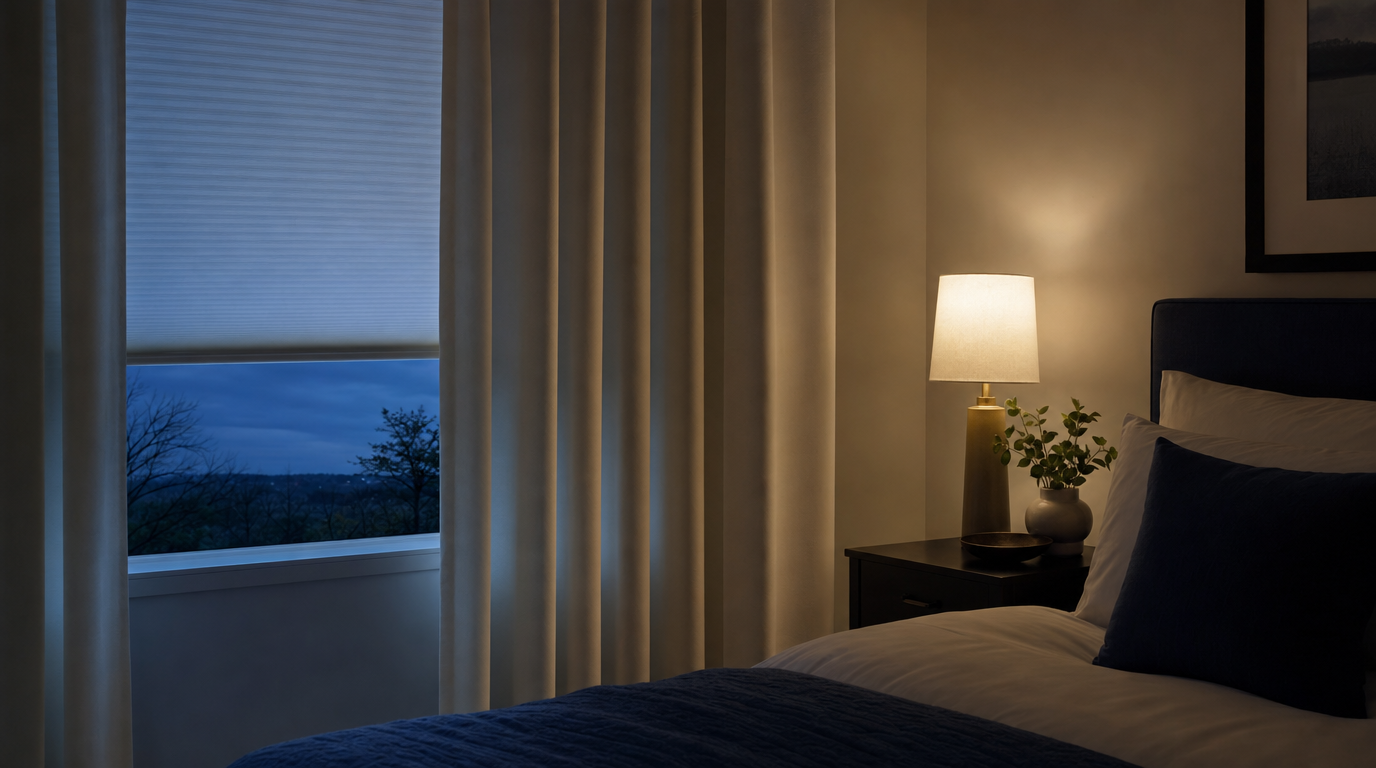
Blackout Curtains vs Blackout Shades for Sleep
Quick Answer
Blackout curtains and blackout shades both aim to reduce the amount of outside light entering a bedroom, but they approach the job differently. Curtains hang from a rod and cover the window and the surrounding wall area, which tends to help with light that sneaks in around the edges of the frame. Shades fit inside or against the window opening itself, which tends to give a closer, more tailored seal against the glass but can leave more room for light along the sides if the fit is not precise.
Neither option is universally “better.” The right choice generally depends on whether you rent or own, how much light your room actually gets, your budget comfort, and how much you care about the room’s look versus pure function. Many people who deal with particularly bright rooms find that combining both, a shade close to the glass and a curtain over the top, tends to offer the most complete coverage.
Table of Contents
- How Blackout Curtains Work
- How Blackout Shades Work
- Comparison Table
- Which Tends to Suit Renters vs Homeowners
- Combining Both for Maximum Darkness
- Common Mistakes When Choosing Either Option
- How This Fits Into a Broader Dark-Room Routine
- FAQ
How Blackout Curtains Work
Blackout curtains generally rely on a tightly woven or specially backed fabric that resists light passing through it, combined with panels that are cut and hung wider and longer than the window itself. Because the panels extend beyond the window frame on all sides, they tend to cover the gaps at the edges, top, and bottom where light usually gets in, rather than relying only on the fabric’s density.
The mounting style matters as much as the fabric. Curtains hung close to the wall, with a rod that extends well past the window frame, tend to leave fewer visible gaps than curtains hung directly on a narrow rod sized to the window. Some people add side channels, magnetic strips, or a valance across the top to further reduce the light that leaks around the edges, though results can vary by window shape and room layout.
Because curtains are a soft, drapable material, they also tend to add visible texture and warmth to a room, and they are usually easy to open fully during the day without leaving any hardware in the way.
How Blackout Shades Work
Blackout shades generally work by fitting directly against or inside the window frame, using a roller, cellular, or panel mechanism that raises and lowers flush with the glass. Because the shade sits close to the window itself rather than draping around it, it tends to block the light coming straight through the glass fairly effectively, though light can still find a way in along the side channels if the shade is not cut to a close fit.
Shades that mount inside the window frame (“inside mount”) tend to look tidier and more built-in, while shades that mount just outside the frame (“outside mount”) tend to cover more of the gap area and can reduce edge light more effectively. The tradeoff is usually installation precision: a shade needs to be measured and fitted more exactly than a curtain, since there is less fabric slack to compensate for a slightly off measurement.
Shades also tend to have a cleaner, more minimal look when closed, and many styles can be raised only partway, which some people find useful for adjusting light levels gradually rather than choosing between fully open and fully closed.
Comparison Table
The table below compares blackout curtains and blackout shades across the practical factors that tend to matter most when choosing between them.
| Factor | Blackout Curtains | Blackout Shades |
|---|---|---|
| Installation difficulty | Generally simple; a rod and hooks can often be hung without precise measuring | Generally requires more precise measuring and mounting for a close fit |
| Light-blocking approach | Covers the window and surrounding wall area to reduce edge gaps | Seals close to the glass itself, within or against the frame |
| Cost tendency | Can range widely depending on fabric, width, and length; often flexible for tight budgets | Can range widely depending on mechanism and fit; custom sizing can add cost |
| Rental-friendliness | Often easier for renters since curtain rods rarely require permanent changes to the window | Can be more involved for renters if brackets or inside-mount hardware affect the window frame |
| Aesthetic flexibility | Wide range of fabrics, colors, and styles; adds softness to a room | Tends to offer a cleaner, more minimal look; fewer decorative variations |
| Maintenance | Fabric may need occasional washing or dusting depending on material | Typically wiped down rather than washed; mechanism may need occasional cleaning or adjustment |
Which Tends to Suit Renters vs Homeowners
Renters often lean toward curtains because a tension rod or a rod mounted with removable brackets can usually be installed and removed without leaving significant marks on the wall or window frame. This makes curtains a common choice when a lease restricts drilling or when a tenant wants to take the window coverings with them at move-out.
Homeowners, or renters with more flexibility in their lease, may lean toward shades because they can commit to inside-mount hardware without worrying about restoring the window frame later. A closer, more built-in fit can also make sense as a longer-term investment in a room’s overall design, since shades are less likely to be swapped out as often as curtain styles might be.
That said, this is a general tendency rather than a strict rule. Some rental agreements allow outside-mount brackets, and some homeowners prefer the flexibility and lower commitment of curtains. It is worth checking a lease or building policy before assuming either option is off the table.
Combining Both for Maximum Darkness
For rooms that get particularly bright light, such as a west-facing window at sunset or a streetlight positioned close to the glass, many people find that layering a shade behind a curtain tends to address more of the small gaps than either option alone. The shade handles the light coming straight through the glass, while the curtain’s wider panel helps cover the edges around the frame and any light that might reflect off the wall near the window.
This layered approach can also add flexibility. A shade can be adjusted for daytime privacy or partial light without needing to fully open heavy curtain panels, while the curtain can be closed on top when maximum darkness is the goal, such as for a nap or an early bedtime during longer daylight hours.
Layering does mean more hardware, more cost, and more to install, so it tends to make the most sense for rooms where a single layer has already proven insufficient, rather than as a starting point for every bedroom.
Common Mistakes When Choosing Either Option
- Buying curtain panels sized exactly to the window instead of wider, which tends to leave visible light gaps at the sides.
- Mounting a curtain rod directly above the window frame instead of higher and wider, which reduces the coverage of edge gaps.
- Measuring a shade incorrectly for an inside mount, leaving side channels that let light through.
- Assuming any curtain labeled “room darkening” performs the same as one labeled “blackout,” when the two terms are often used to describe different levels of light reduction.
- Choosing a shade or curtain based on appearance alone without considering how the room’s light exposure actually changes throughout the year.
- Overlooking small light sources in the room itself, such as electronics or hallway light under a door, and expecting window coverings alone to fully darken the space.
How This Fits Into a Broader Dark-Room Routine
Window coverings are usually just one part of building a darker bedroom. Door gaps, small electronic lights, and hallway light can all still let brightness into an otherwise well-covered room. For a fuller room-by-room approach, see How to Make Your Bedroom Darker for Better Sleep.
If your window coverings cannot fully solve a light problem, such as when traveling or sharing a room where you cannot install anything, a sleep mask can be a portable alternative or supplement. See Does a Sleep Mask Help You Sleep Better? for a closer look at when that option makes sense.
Darkness is also just one piece of a broader sleep environment. For a wider set of practical habits and environment adjustments, see the Sleep Hygiene Guide.
FAQ
Are blackout curtains or blackout shades better for sleep?
Neither is universally better. Curtains tend to cover more of the wall area around a window, which can help with edge gaps, while shades tend to seal closer to the glass itself. The better option generally depends on your room’s light exposure, whether you rent or own, and how much you value appearance versus a tailored fit.
Do blackout curtains and room darkening curtains mean the same thing?
Not usually. These terms are often used to describe different levels of light reduction, with “blackout” generally implying a fabric or construction intended to block more light than a standard “room darkening” curtain. It is worth checking a product’s specific description rather than assuming the terms are interchangeable.
Can I use blackout curtains and shades together?
Yes. Many people layer a shade close to the window with a curtain over the top for fuller coverage, particularly in rooms with strong or persistent outside light. This approach tends to address more of the small gaps than either option used alone.
Are blackout shades or curtains easier to install in a rental?
Curtains are often easier for renters because a tension rod or removable bracket typically avoids permanent changes to the window frame. Shades can be more involved if they require drilling or inside-mount hardware, though some rental agreements do allow outside-mount options. Check your lease before installing either.
Do blackout curtains or shades affect a room’s temperature?
Both are generally thought to add a mild insulating effect simply by covering the window, though how noticeable that is depends on the material, fit, and the window itself. If keeping the room cooler or warmer is a priority, treat this as a secondary benefit rather than the main reason to choose one option over the other.
How do I stop light from leaking around the edges of curtains or shades?
For curtains, hanging the rod higher and wider than the window frame tends to reduce edge gaps. For shades, choosing an outside mount or a closer-fitting inside mount can help. Some people also add side channels, magnetic strips, or a valance to further reduce light leaks, though results can vary by window shape.
Bottom Line
Blackout curtains and blackout shades both work toward the same goal, a darker bedroom, but they get there in different ways. Curtains tend to be simpler to install, more flexible for renters, and offer more room to express style through fabric and color. Shades tend to offer a closer, more built-in seal against the window and a cleaner look, which can suit homeowners or longer-term setups. If one option alone is not enough for a particularly bright room, layering both is a practical way to close the remaining gaps. Whichever you choose, remember that window coverings are just one part of a fully dark room, alongside door gaps, small lights, and the rest of your sleep environment.



One Comment