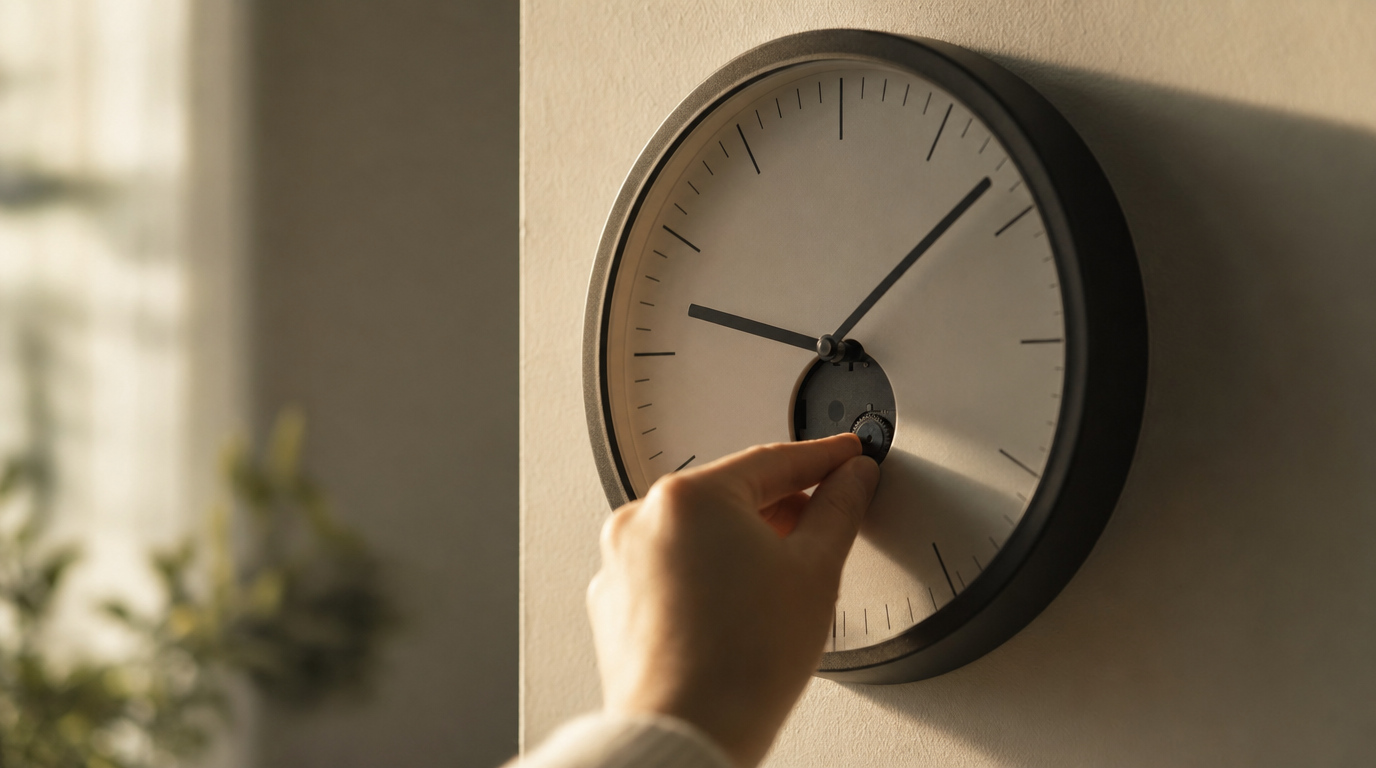
Daylight Saving Time Sleep Schedule Adjustment
A one-hour shift might sound minor, but many people notice a real disruption to their sleep and energy for several days after daylight saving time changes. Because the body’s internal clock relies on consistent timing cues, especially light exposure, even a small shift in the clock can throw off sleep timing more than expected.
This guide covers how to prepare for the transition in either direction, why “springing forward” tends to feel harder than “falling back,” and practical steps to speed up adjustment.
Quick Answer
Many people find it easier to adjust to daylight saving time by shifting bedtime and wake time by 15 to 20 minutes per day in the days leading up to the change, rather than absorbing the full hour shift all at once. Getting morning light exposure and being consistent with the new schedule for the first several days also helps the body’s internal clock catch up faster. The “spring forward” change tends to feel harder than “falling back,” since losing an hour of sleep is generally more disruptive than gaining one.
Table of Contents
- Why a one-hour shift disrupts sleep
- Why “spring forward” feels harder than “fall back”
- Preparing in the days before the change
- Speeding up adjustment after the change
- How long adjustment usually takes
- Common mistakes
- FAQ
Why a one-hour shift disrupts sleep
The body’s internal clock relies heavily on consistent daily cues, particularly light and darkness, to regulate when it feels sleepy and when it feels alert. When clocks shift by an hour but your body’s internal timing does not shift instantly, there’s a mismatch between what the clock says and what your body expects, which many people experience as grogginess, trouble falling asleep at the “new” bedtime, or waking up at an odd hour relative to the new schedule.
Why “spring forward” feels harder than “fall back”
In spring, clocks move forward an hour, which effectively means losing an hour of sleep opportunity that night. In fall, clocks move back, which effectively gains an hour. Many people find losing sleep noticeably harder to adjust to than gaining it, since it means going to bed at what feels like an earlier time relative to your body’s expectations, rather than simply having more time available to sleep.
Preparing in the days before the change
- In the 3 to 4 days before the time change, shift your bedtime and wake time by 15 to 20 minutes in the direction of the upcoming change.
- Keep this shift gradual rather than trying to absorb the full hour in a single night.
- Adjust meal times and caffeine timing slightly along with your sleep schedule, since these also act as cues for your internal clock.
- Get morning light exposure at your new intended wake time to help reinforce the shift.
Speeding up adjustment after the change
If you didn’t prepare in advance, the same tools still help after the change: consistent wake times, morning light exposure, and avoiding naps that are too long or too late in the day. For more on general light-based sleep cues, see Morning Sunlight and Sleep. Keeping a consistent bedtime for the new schedule, rather than drifting, tends to shorten the adjustment period.
If falling asleep at the new bedtime is difficult in the first few days, a short wind-down routine can help signal the shift to your body — see Night Routine for Better Sleep.
How long adjustment usually takes
Most people adjust to a one-hour daylight saving time change within about a few days to a week, though this varies by individual and by how consistent the new schedule is kept. Preparing gradually beforehand tends to shorten this window compared to adjusting all at once on the day of the change.
Common mistakes
- Waiting until the day of the change to adjust, rather than shifting gradually beforehand.
- Sleeping in significantly to compensate, which can make the adjustment take longer overall.
- Ignoring morning light exposure, which is one of the strongest cues for resetting the internal clock.
- Drinking more caffeine to compensate for grogginess, which can interfere with adjusting to the new bedtime.
- Assuming the disruption will last indefinitely rather than expecting it to resolve within about a week.
FAQ
How can I prepare for daylight saving time before it happens?
Shifting your bedtime and wake time by 15 to 20 minutes per day for 3 to 4 days before the change, in the direction of the upcoming shift, can make the adjustment feel more gradual.
Why does losing an hour in spring feel worse than gaining one in fall?
Losing an hour of sleep opportunity is generally more disruptive to the body’s internal clock than gaining one, since it effectively moves bedtime earlier relative to what your body expects.
How long does it take to adjust to a time change?
Most people adjust within a few days to about a week, especially with consistent wake times and morning light exposure. Preparing gradually beforehand can shorten this.
Does morning light really help with the adjustment?
Morning light exposure is one of the most commonly cited tools for resetting the body’s internal clock, since light is a primary cue the body uses to regulate its sleep-wake timing.
Is it bad to sleep in to compensate after the clock change?
Sleeping in significantly can make it harder to reset your schedule, since it delays exposure to morning light and shifts your other daily cues later as well. A consistent wake time tends to help the adjustment go faster.
Bottom Line
Daylight saving time changes disrupt sleep more than a single hour might suggest, largely because the body’s internal clock relies on consistent timing cues. Gradually shifting your schedule beforehand, prioritizing morning light, and staying consistent afterward can shorten the adjustment period to about a week or less for most people.
For more on light-based sleep cues, see Morning Sunlight and Sleep. For a broader wind-down routine to support the transition, see Night Routine for Better Sleep. And for schedule changes more generally, see How to Fix a Sleep Schedule.