How to Choose a Humidifier for a Bedroom: A Practical Buying Guide
Choosing a humidifier for your bedroom can feel confusing: there are several types, different capacity claims, and features that manufacturers highlight. Many people want something quiet, easy to clean, and sized correctly for their room.
This guide breaks down the common humidifier types, the features that matter for sleep, placement and maintenance tips, and mistakes people often make so you can choose a model that supports more comfortable rest.
Quick Answer
Pick a humidifier that matches your bedroom size, is easy to clean, and runs quietly; consider an ultrasonic or evaporative unit for bedrooms, and prioritize simple maintenance and reliable humidity monitoring.
Table of Contents
- Why bedroom humidity matters
- Common humidifier types
- Key features to compare when buying
- Placement and setup tips for the bedroom
- Maintenance and cleaning basics
- When to talk to a doctor
- Common mistakes
- FAQ
- Bottom Line
Why bedroom humidity matters
Indoor humidity affects perceived air dryness and comfort for breathing, skin, and nasal passages, which in turn can influence how comfortable you feel while trying to sleep. Many people notice better nasal comfort and less throat dryness when indoor air is not overly dry. Conversely, too much humidity can leave a room feeling muggy and may encourage condensation on windows.
Common humidifier types
- Evaporative (wick) humidifiers: Use a fan to blow air through a moistened wick. They tend to self-regulate to some degree because evaporation slows when humidity rises.
- Ultrasonic humidifiers: Create a fine mist with high-frequency vibration. They are often quieter and available in cool- or warm-mist options.
- Warm-mist (steam) humidifiers: Heat water to create steam; they may reduce bacteria in the tank due to heat but can be warmer to the touch and use more energy.
- Impeller humidifiers: Use a rotating disk to fling water into a diffuser; they are less common for bedrooms but are another cool-mist option.
Each type has trade-offs around noise, energy use, and cleaning. For many bedrooms, quiet operation and straightforward cleaning are top priorities.
Key features to compare when buying
- Room coverage: Match the unit’s stated room size or output to your bedroom. A too-small device will not change humidity meaningfully; an oversized device may be harder to manage.
- Run time and tank size: Consider how long the humidifier can run between refills; overnight runtime is useful for many sleepers.
- Noise level: Look for quiet or sleep modes if you are noise-sensitive. Ultrasonic models are often quieter than fan-based units.
- Controls and monitoring: Built-in humidistats or compatibility with a separate hygrometer help avoid over-humidifying. Simple, reliable controls are often better than many settings you’ll never use.
- Filter and maintenance needs: Some units use replaceable filters; others have filter-free tanks. Factor in ongoing filter costs and how easy filter changes are.
- Ease of cleaning: Choose a design with accessible tank openings and removable parts to reduce mold and mineral buildup risk.
Placement and setup tips for the bedroom
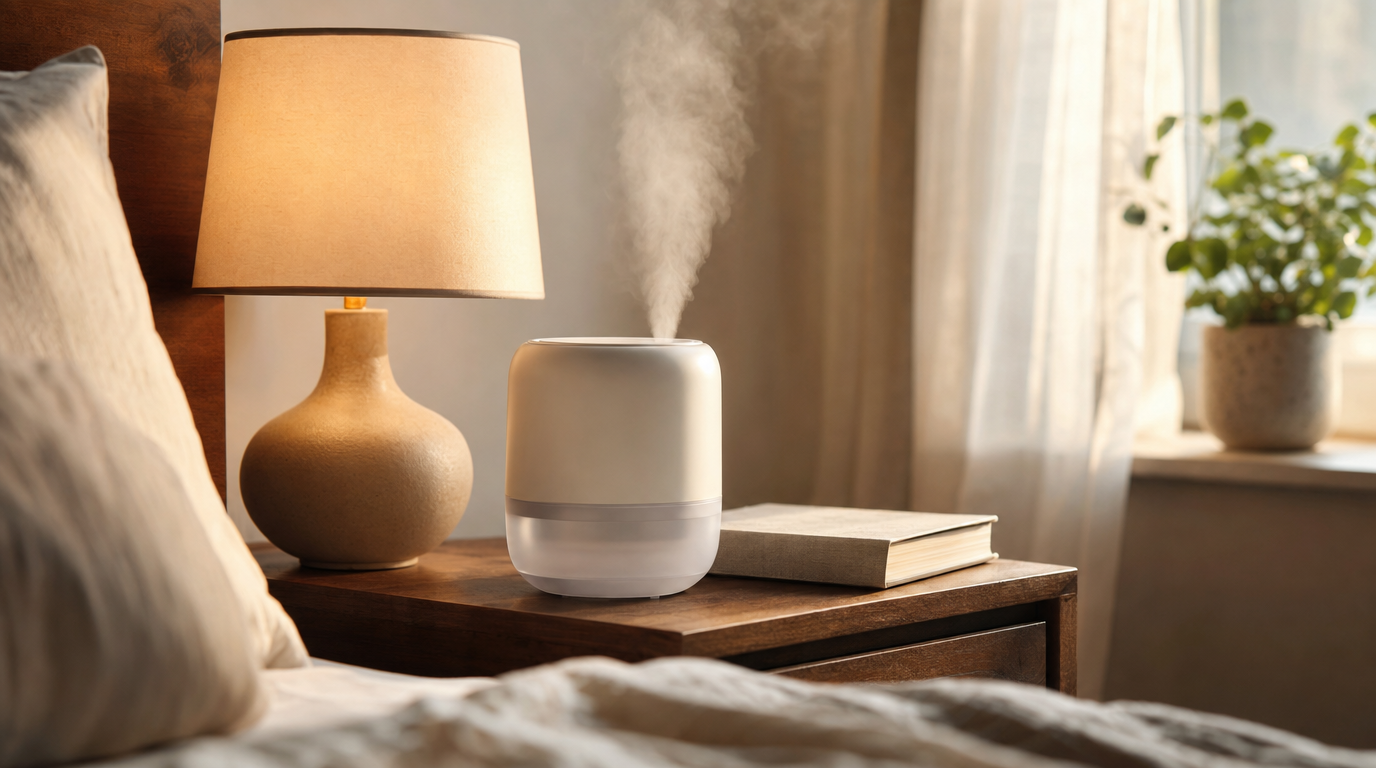
Place the humidifier on a flat, elevated surface at least a few feet from the bed so mist disperses evenly and so bedding or furniture do not get damp. Avoid placing it directly against walls or on wood surfaces without a waterproof tray. If your humidifier has a directional nozzle, angle it away from electronics and textiles.
Maintenance and cleaning basics
- Empty and refill the tank daily or as the manufacturer suggests to reduce stagnant water.
- Clean the tank and base regularly with a mild, manufacturer-approved routine to prevent mineral buildup and microbial growth.
- Use distilled or demineralized water if your tap water is very hard; this can reduce visible white dust from ultrasonic units.
- Replace filters on the schedule recommended by the maker if your model uses them.
When to talk to a doctor
If you have breathing symptoms, recurring sinus problems, or suspected mold growth in your home, it’s reasonable to discuss humidifier use with a healthcare professional. Health issues that affect breathing or cause frequent nasal congestion may need medical attention rather than only environmental changes; a clinician can help you decide whether a humidifier is appropriate. For more on how we handle medical guidance and editorial standards, see our medical disclaimer and editorial policy.
Common mistakes
- Buying a unit that’s too small for the bedroom and expecting big results.
- Neglecting routine cleaning, which can allow mineral or microbial buildup.
- Running the humidifier constantly without monitoring indoor humidity.
- Placing the unit too close to bedding or wooden furniture.
- Assuming more humidity is always better — very high humidity can create other problems.
FAQ
What humidity level is best for sleeping?
Most people sleep best with moderate indoor humidity — not very dry and not overly damp. Using a hygrometer can help you monitor and aim for a comfortable range for your room.
Which humidifier type is quietest for a bedroom?
Ultrasonic humidifiers are often quieter than fan-based evaporative models, but noise can vary by model; look for sleep or low-noise settings if sound matters to you.
How often should I clean my bedroom humidifier?
Many people benefit from emptying and refilling the tank daily and doing a deeper clean weekly, though exact frequency depends on the device and your water quality; follow the manufacturer’s cleaning recommendations.
Can a humidifier help with allergies?
A humidifier may ease drying-related nasal irritation for some people, but it won’t treat allergic triggers. If you suspect allergy-related symptoms, consult a healthcare professional for personalized advice.
Can a humidifier cause mold in my bedroom?
Excessive indoor humidity can encourage condensation and mold growth. Monitoring humidity and following maintenance guidelines can reduce this risk.
Bottom Line
When choosing a bedroom humidifier, match the unit to your room size, favor models that are easy to clean and quiet, and monitor indoor humidity so you don’t overdo it. Regular maintenance and thoughtful placement matter as much as the type you pick. For more on how humidity affects sleep, see How Humidity Affects Sleep Quality. For general, non-product sleep tips that pair well with humidity management, see How to Sleep Better Naturally and How to Sleep Better in Hot Weather.