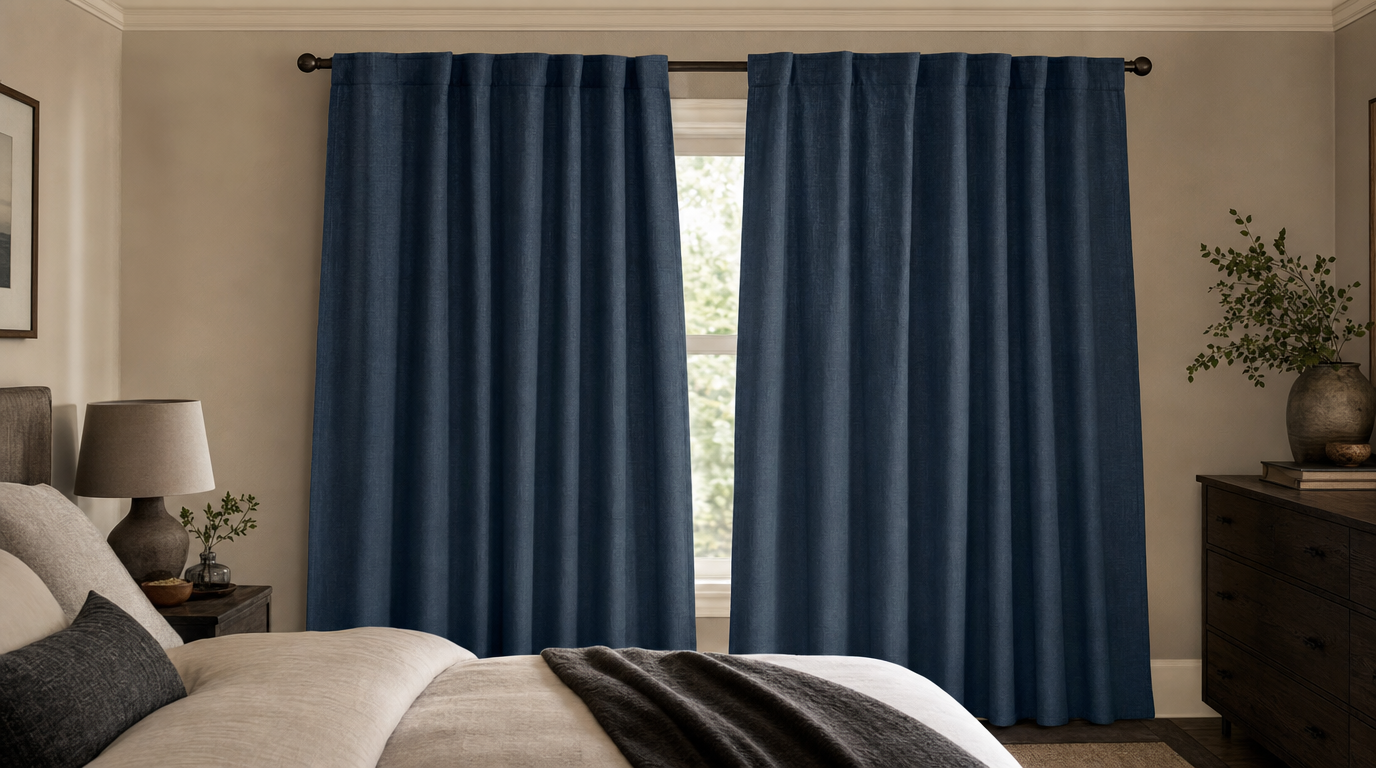
How to Choose Blackout Curtains for Sleep
Quick Answer
Choosing blackout curtains for sleep comes down to a handful of practical decisions rather than one “best” product: fabric weight and lining, panel length and width, how and where you mount the rod, and how carefully you read the difference between “blackout” and “room darkening” labeling. Heavier, lined fabric generally blocks more light than a thin single layer, panels cut wider and longer than the window tend to leave fewer gaps, and a rod mounted higher and wider than the frame usually helps more than the fabric alone.
If you are still deciding whether curtains or shades are the right category for your room, see Blackout Curtains vs Blackout Shades for Sleep for that comparison first. This guide assumes you have settled on curtains and walks through how to choose the right ones.
Table of Contents
- Fabric Weight and Layers
- Sizing: Length, Width, and Mounting
- Room-Darkening vs Blackout Labeling
- Color and Perceived Darkness
- Care and Cleaning Considerations
- Pre-Purchase Checklist
- Common Mistakes
- FAQ
Fabric Weight and Layers
The fabric itself is usually the first thing people look at, and for good reason. Heavier, more tightly woven fabric generally blocks more light than a thin, loosely woven one, simply because there is less open space between fibers for light to pass through. Many blackout curtains add a separate lining layer, often sewn to the back of a decorative face fabric, which does the actual light-blocking work while the visible fabric handles the look of the room.
Single-layer curtains marketed as “blackout” typically rely on a dense weave or a coating baked into the fabric itself, without a separate lining. These can still work well, but a lined, multi-layer panel tends to be more forgiving if the base fabric is a lighter color or a looser weave, since the lining does most of the blocking regardless of what the outer layer looks like. If darkness is your main priority, a lined panel is generally the safer choice; if you care more about a specific color or texture on the visible side, a lining lets you have that look without giving up as much light control.
It is worth handling the fabric in person or looking closely at product photos before buying. Holding a fabric sample up to a light source, even a phone flashlight, can give you a rough sense of how much light passes through before you commit to a full set of panels.
Sizing: Length, Width, and Mounting
Sizing tends to matter as much as fabric choice, and it is the step people most often get wrong. Panels cut to match the window’s exact width tend to leave visible gaps at the sides, since the fabric has no slack to overlap the frame. Choosing panels noticeably wider than the window, so they extend well past each side of the frame when closed, tends to reduce those edge gaps considerably.
Length works the same way. Panels that stop right at the windowsill or floor with no extra allowance can leave a gap at the bottom where light gets in, especially once curtains settle after hanging for a while. Many people choose panels that puddle slightly on the floor or hang just past the sill for a closer seal, though this is partly a style preference as well as a functional one.
Mounting height and width matter just as much as the panels themselves. A rod mounted close to the top of the window frame, sized to match the frame’s width, tends to leave more light passing above and beside the curtains. Mounting the rod higher on the wall and extending it several inches beyond each side of the frame generally gives the fabric more coverage to work with, so the panels can fully clear the window opening and overlap the wall when drawn. Some people add side channels, a valance across the top, or magnetic or hook-and-loop closures along the edges to close remaining gaps, though how much these help can vary by window shape and how precisely they are installed.
Room-Darkening vs Blackout Labeling
Product listings often use “blackout” and “room darkening” as if they mean the same thing, but they generally describe different levels of light reduction. “Blackout” is typically used for fabric or construction intended to block most light passing directly through the panel, while “room darkening” is generally used for fabric that reduces light noticeably without aiming for the same level of blocking. Neither term is standardized the same way across every retailer, so the label alone should not be the only thing you rely on.
Rather than assuming a specific percentage of light blocked, which most listings do not verify in a consistent or independently tested way, it is more useful to read the full product description, check whether a separate blackout lining is mentioned, and look at close-up photos of the fabric’s weave or backing. If a listing is vague about construction and only uses the word “blackout” in the title, treat that as a starting point for research rather than a guarantee.
Keep in mind that even genuinely blackout-rated fabric only controls light passing through the panel itself. Gaps at the edges, top, and bottom from sizing or mounting choices can let in as much or more light than the fabric blocks, which is why sizing tends to matter just as much as the fabric rating.
Color and Perceived Darkness
Darker outer colors, such as deep navy, charcoal, or black, tend to feel more effective at creating a dark room, partly because they absorb rather than reflect the light that does get through any small gaps. Lighter colors can still block a similar amount of light if the lining underneath is doing the work, but a light-colored panel may let a faint glow show through the fabric itself in a very bright room, even when the overall room is noticeably darker than it would be without curtains.
Color also affects how a room feels once the curtains are closed, which is worth considering separately from pure light control. A very dark, heavy panel can make a small room feel more enclosed, while a mid-tone or lined lighter fabric can offer a lot of the same light-blocking benefit with a softer look. If you are unsure, prioritizing a good lining over a specific outer color tends to give more flexibility, since the lining is doing most of the functional work regardless of what color you see from inside the room.
Care and Cleaning Considerations
Care requirements vary by fabric and construction, so it is worth checking the care label before buying rather than after. Some blackout curtains are machine washable, while others, especially those with a bonded or coated lining, may recommend gentle cycles, air drying, or dry cleaning only, since heat and heavy agitation can damage the lining layer over time.
Regular dusting or vacuuming with a soft brush attachment can help curtains stay fresher between washes, particularly in bedrooms where fabric tends to collect dust. If a panel has a separate removable lining, some manufacturers allow washing the outer fabric and lining separately, which can extend the life of both. When in doubt, following the manufacturer’s specific care instructions is more reliable than assuming all blackout curtains can be cared for the same way.
Pre-Purchase Checklist
Before buying, it can help to run through a short checklist so you are not relying on the word “blackout” alone.
- Measure your window’s width and height, then plan for panels and a rod noticeably wider and, ideally, mounted higher than the frame.
- Check whether the listing mentions a separate blackout lining, and read the fabric description rather than relying on the title alone.
- Decide whether floor-length, puddling, or sill-length suits both your light-control goals and your room’s style.
- Confirm the rod or mounting hardware you plan to use can support the weight of a heavier, lined fabric.
- Read the care label before buying, especially if you expect to wash the curtains regularly.
- Consider the outer color in terms of both room feel and how much it might show light through the fabric in a very bright room.
Common Mistakes
- Buying panels sized exactly to the window instead of wider, leaving visible light gaps at the sides.
- Mounting the rod directly above the window frame instead of higher and wider, reducing coverage of edge gaps.
- Assuming any curtain labeled “room darkening” performs the same as one labeled “blackout,” when the two terms often describe different levels of light reduction.
- Choosing fabric based on color alone without checking whether a blackout lining is actually included.
- Skipping the care label and later finding the fabric cannot be washed the way you expected.
- Overlooking small light sources in the room itself, such as electronics or a gap under the door, and expecting curtains alone to fully darken the space.
FAQ
What is the most important factor when choosing blackout curtains for sleep?
Fabric and sizing generally matter together rather than one alone. A heavier, lined fabric tends to block more light through the panel itself, but panels that are too narrow or too short can leave gaps that let in just as much light regardless of how dense the fabric is. Getting both right tends to matter more than focusing on either one in isolation.
How much wider than my window should blackout curtains be?
There is no single fixed measurement that fits every window, but panels and a rod that extend noticeably beyond each side of the frame generally leave fewer edge gaps than panels sized to match the window exactly. Checking the specific product’s sizing guidance against your own window measurements is more reliable than assuming a standard width will work.
Do darker colored curtains block more light than lighter ones?
Not necessarily. A lighter-colored panel with a proper blackout lining can block a similar amount of light to a dark one, since the lining does most of the functional work. Darker outer colors do tend to absorb more of any light that does get through small gaps, which can make a room feel slightly darker even when the actual light blocked is similar.
Is “blackout” always better than “room darkening” curtains?
For sleep specifically, curtains labeled “blackout” are generally intended to block more light than those labeled “room darkening,” but the terms are not standardized identically across every retailer. Reading the full fabric and lining description is a more reliable way to judge a specific product than relying on the label alone.
Can blackout curtains be machine washed?
It depends on the specific fabric and lining. Some blackout curtains are machine washable on a gentle cycle, while others with a bonded or coated lining may recommend air drying or dry cleaning only. Checking the care label before purchase can help you avoid a mismatch between how you plan to clean them and how they are actually meant to be cared for.
Should I choose curtains or shades if I want the darkest possible room?
That depends on your specific window and living situation rather than one category being universally darker. See Blackout Curtains vs Blackout Shades for Sleep for a fuller comparison, including how layering both can address gaps that either option alone might miss.
Bottom Line
Choosing blackout curtains for sleep is mostly a matter of getting the fundamentals right: a well-lined, appropriately heavy fabric, panels sized wider and longer than the window, and a rod mounted to maximize coverage rather than fit the frame exactly. Color and care are worth factoring in, but they matter less than fabric and sizing if darkness is your main goal. For a broader look at reducing bedroom light beyond the window itself, see How to Make Your Bedroom Darker for Better Sleep. And if curtains alone cannot fully solve a light problem, such as while traveling or sharing a room, see Does a Sleep Mask Help You Sleep Better? for a portable alternative. If you are still weighing curtains against shades as a category, revisit Blackout Curtains vs Blackout Shades for Sleep before making a final decision.



One Comment