Best Bedside Lighting for Sleep: A Practical Guide
Quick Answer
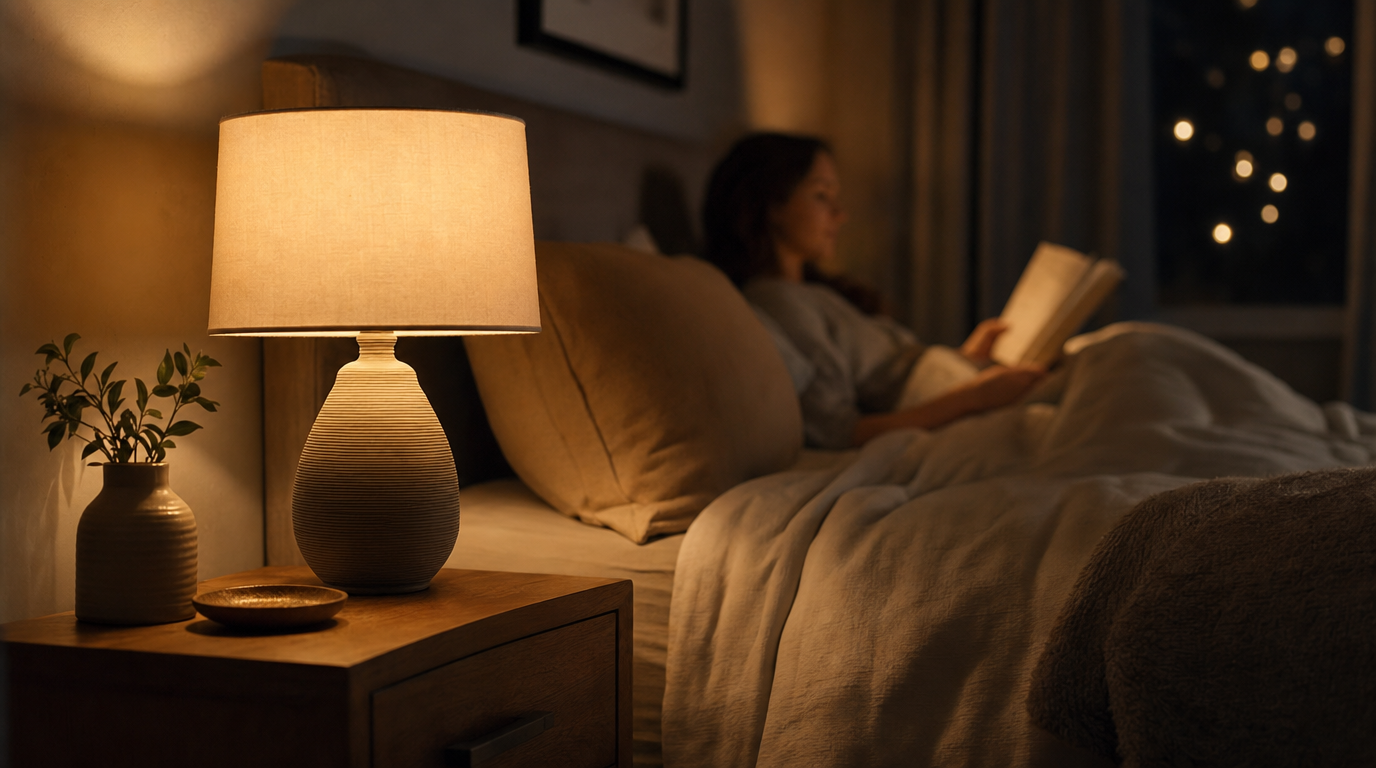
The best bedside lighting for sleep is usually a lamp you can dim, that gives off a warmer-toned glow rather than a stark white one, and that sits within easy reach so you are not fumbling for a switch in the dark. It is less about finding one specific “correct” bulb and more about having lighting you can adjust as the evening winds down, so the last light you see before sleep is soft rather than bright and abrupt.
This guide focuses on the practical side of nightstand lighting: what to look for in a bedside lamp, when to start using lower light in the evening, how to think about nightlights and overnight lighting, and mistakes that quietly undo an otherwise good wind-down routine. If you want the deeper science on why light color and wavelength matter, that is covered separately in Does Blue Light Affect Sleep? and Red Light vs Blue Light Before Bed.
Table of Contents
- Why Evening Lighting Choices Matter for a Wind-Down Routine
- What to Look for in a Bedside Lamp
- Timing: Using Lower Light in the Hour or So Before Bed
- Nightlights and Overnight Lighting Considerations
- Common Mistakes
- FAQ
Why Evening Lighting Choices Matter for a Wind-Down Routine
Many people find that a bright, evenly lit room in the evening feels more like daytime than downtime. Overhead lights and cool white fixtures are built for tasks like cooking, cleaning, or reading fine print, not for signaling to your body and mind that the day is winding down. Swapping that kind of lighting for a dimmer, warmer-toned lamp in the last part of the evening can make the transition to bed feel less abrupt.
This is not about a single dramatic change. It is about giving yourself a consistent cue. If your evening routine always includes turning off the main lights and switching to a softer bedside lamp, that shift can become a small, repeatable signal that bedtime is approaching, similar to brushing your teeth or changing into sleepwear. For a broader look at building that kind of routine, see Night Routine for Better Sleep.
It is worth being honest about limits here. A lamp alone will not fix a sleep problem rooted in stress, an irregular schedule, caffeine timing, or a disruptive environment. But lighting is one of the easier variables to control, and for many people, dimmer and warmer light in the evening simply feels more comfortable to wind down with than bright, cool-toned light.
What to Look for in a Bedside Lamp
When you are thinking about nightstand lighting, a few practical features matter more than any specific brand or style.
Dimmability
A lamp with a built-in dimmer, or one paired with a dimmable bulb, gives you control over how much light fills the room at different points in the evening. You might want more light while reading or getting ready, and much less once you are actually trying to fall asleep. A fixed, single-brightness lamp does not let you make that adjustment, so dimmability is one of the most useful features to prioritize.
Warm tone options
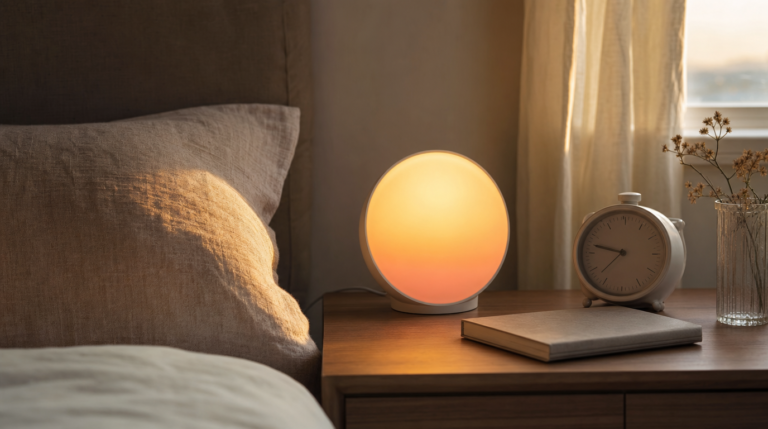
In general, warmer-toned light (the kind that leans amber or soft yellow rather than stark white or blue-white) tends to feel more relaxing to people in the evening. You do not need to chase a specific technical spec to get this benefit. Many bedside lamps, shades, and bulbs are designed to give off a warmer glow by default, and that qualitative “warm and soft” feel is generally what to aim for rather than a precise number.
Placement and reach
A bedside lamp only helps your routine if it is actually within easy reach from where you sleep. Consider how far you would need to stretch to turn it on or off, whether the switch is easy to find without your glasses or in low light, and whether the cord and base fit comfortably on your nightstand without becoming a trip hazard or a source of clutter.
Ease of use in the dark
Fumbling for a small switch or a touch-sensitive base in the dark can undercut the calm you were trying to create. Look for a lamp with a switch or control you can find by feel, a touch-sensitive base that responds reliably, or a remote or app control if that fits your habits better. The goal is to turn the light on or off without needing to fully wake up or turn on a brighter light to find the switch.
Timing: Using Lower Light in the Hour or So Before Bed
Many people find it helpful to start dimming their environment in the hour or so before they actually intend to fall asleep, rather than switching abruptly from bright overhead lighting to total darkness. This gives your evening a gradual taper instead of a hard stop, and it gives you time to finish tasks like reading, tidying up, or getting ready for bed while the room is already easier on the eyes.
A simple approach is to treat it as a sequence: full room lighting while you finish up active tasks, then a switch to just the bedside lamp on a lower setting as you move into your wind-down routine, and finally the lamp off (or on its lowest, dimmest setting) once you are ready to sleep. There is no single confirmed window that works for everyone, and the right timing will vary by person and household. Treat it as part of your wind-down routine rather than a strict schedule, and adjust based on what actually leaves you feeling ready for bed.
It also helps to think about this alongside your screens. Bright phone or tablet screens close to bedtime can work against a dimmed room. If you want the deeper explanation of how light color and screens fit into this picture, see Does Blue Light Affect Sleep? and Red Light vs Blue Light Before Bed.
Nightlights and Overnight Lighting Considerations
Some people prefer complete darkness overnight, while others want a small amount of light available for nighttime trips to the bathroom or to check on a child. Both are reasonable, and the right answer depends on your household, safety needs, and personal preference.
If you do want a nightlight, a few practical points can help it work with your sleep rather than against it. Choose the dimmest option that still lets you move safely, position it low and out of your direct line of sight from the bed (near the floor or in a hallway rather than at eye level), and favor a warmer, softer glow over a bright or stark white one. A small plug-in nightlight near the door or hallway is often less disruptive than a bright lamp left on beside the bed.
Also consider the small sources of light you might be overlooking: charging cables, alarm clock displays, router lights, or gaps around curtains. These are not lamps, but they contribute to how dark or bright the room actually feels overnight, and they are often easy to dim, cover, or relocate.
Common Mistakes
- Using only bright overhead lighting right up until the moment you turn everything off, with no gradual dimming in between.
- Choosing a bedside lamp with no dimmer or low-light option, so it is either full brightness or completely off.
- Placing the lamp too far to reach comfortably from bed, which discourages actually using it as part of a routine.
- Relying on a phone flashlight or a bright overhead light for nighttime trips instead of a low, warm nightlight.
- Leaving a bright nightlight at eye level instead of positioning it low and out of direct sight.
- Treating a warm-toned lamp as a fix for sleep problems that are actually about stress, schedule, noise, or an inconsistent routine.
FAQ
What is the best type of bedside lighting for sleep?
There is no single required type. A dimmable lamp with a warmer, softer glow that sits within easy reach of your bed generally works well for most people, since it lets you adjust brightness as the evening winds down instead of being stuck at one fixed setting.
Does a warm-toned lamp actually help you fall asleep faster?
Many people find warmer, dimmer light more comfortable and relaxing to wind down with than bright, cool-toned light, but a lamp on its own is not a guaranteed fix for falling asleep faster. It works best as one part of a broader wind-down routine rather than a standalone solution.
Should I use a dimmer switch or just a lower-wattage bulb?
Either can work. A dimmer switch or dimmable bulb gives you more flexibility because you can adjust brightness throughout the evening, while a fixed lower-output bulb gives you a simpler, single-setting option. Choose whichever fits your routine and how often you want to change the brightness.
Is it better to use a nightlight or keep the room completely dark overnight?
Both are reasonable choices. Complete darkness works well for many people, while others prefer a small, dim, warm-toned nightlight for safety or convenience, especially if they need to get up during the night. If you do use one, keep it as dim as possible and positioned low, away from direct eye level.
How far in advance of bedtime should I dim the lights?
Many people find it helpful to start dimming sometime in the hour or so before they plan to sleep, though there’s no single confirmed window that works for everyone. Treat it as part of your wind-down routine rather than a strict schedule, and adjust the timing based on what feels comfortable for you.
Do I need a special “sleep lamp” or can any lamp work?
You do not need a specialized product. Any lamp that you can dim or that gives off a warmer, softer glow, and that is placed within easy reach of your bed, can support a good evening lighting routine. The features that matter are practical ones like dimmability, placement, and ease of use in the dark, not a specific label.
Bottom Line
The best bedside lighting for sleep is not a specific brand or a technical spec, it is a lamp you can dim, that gives off a warm and comfortable glow, and that is placed where you can actually reach it in the dark. Build a simple habit around it: bright light while you finish tasks, a dimmer bedside lamp as you wind down, and minimal, low-positioned light overnight if you need it at all. If you want to understand the deeper science behind light color and evening exposure, read Does Blue Light Affect Sleep? and Red Light vs Blue Light Before Bed. And to see how bedside lighting fits into a complete evening routine, check out Night Routine for Better Sleep.

One Comment